When designing or maintaining an electrical distribution system, one of the most fundamental decisions is selecting the right circuit protection device. Two of the most common low voltage breakers are the Miniature Circuit Breaker (MCB) and the Molded Case Circuit Breaker (MCCB) . While they both serve the same basic purpose—to protect cables and equipment from overcurrents—they are designed for vastly different scales of application.
Choosing the wrong one can lead to unnecessary costs, inadequate protection, or even safety hazards. In this guide, we break down the technical differences, application scenarios, and selection criteria to help you make an informed decision.
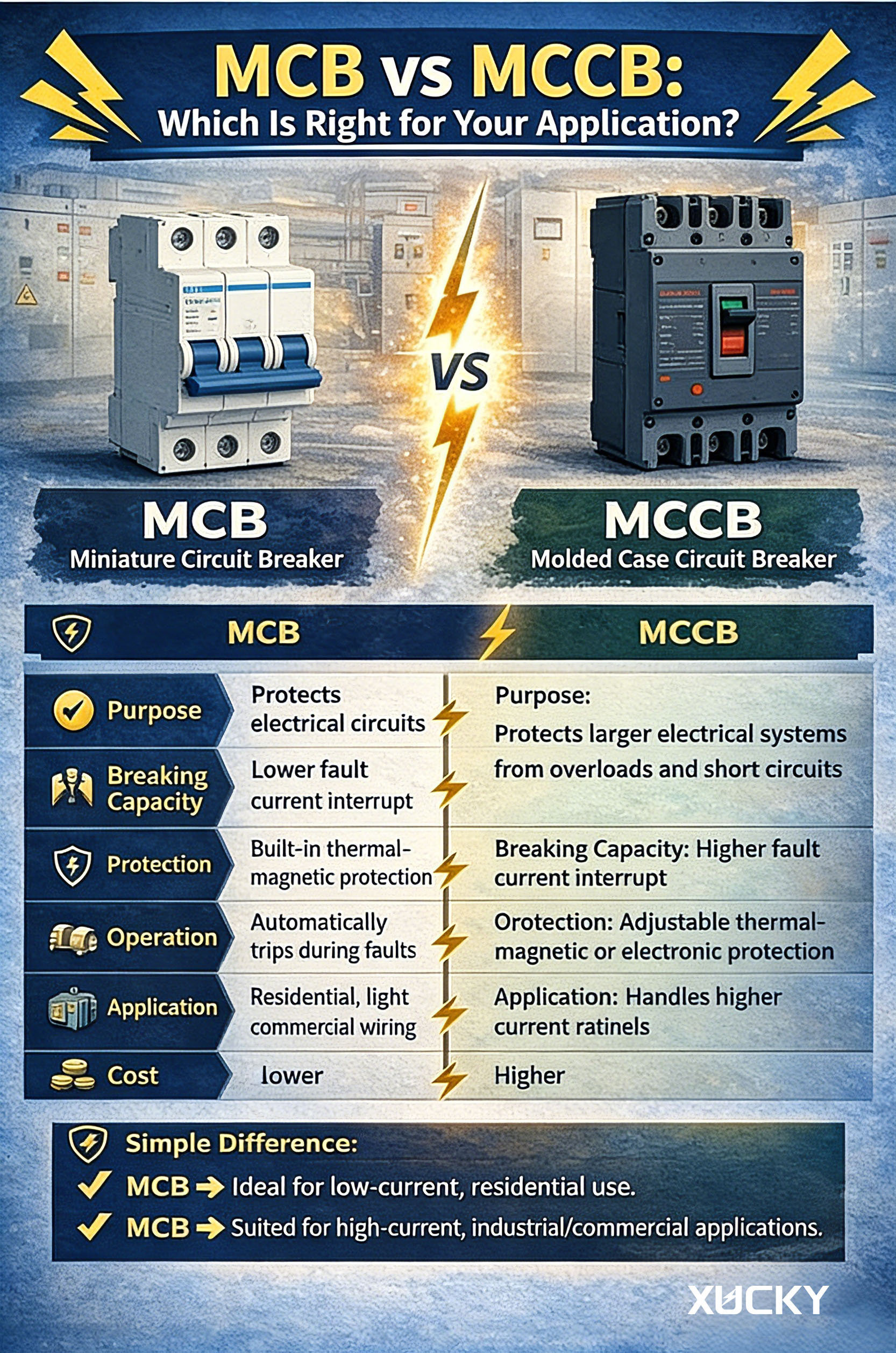
A Miniature Circuit Breaker (MCB) is a thermal-magnetic device designed to protect low-current circuits. It is typically used in residential, commercial, and light industrial applications.
Rated Current (In): Up to 125A (commonly 63A or less).
Breaking Capacity (Icn): Usually up to 10kA or 15kA (sufficient for domestic environments).
Standards: IEC 60898-1 (for household and similar installations) and IEC 60947-2 (for industrial use).
Construction: Fixed thermal and magnetic settings; non-interchangeable trip units.
Size: Compact, typically 1-4 module widths (18mm per pole) on a DIN rail.
MCBs are designed to protect against overloads (slow, sustained overcurrents) via a bimetallic strip and short circuits (high instantaneous currents) via an electromagnetic solenoid. They are not field-adjustable and are intended for final branch circuits.
A Molded Case Circuit Breaker (MCCB) is a larger, more rugged device capable of handling higher currents and providing more sophisticated protection. It is the workhorse of industrial and commercial power distribution.
Rated Current (In): Typically from 15A up to 2500A or more.
Breaking Capacity (Icu): Can range from 18kA to 200kA, making them suitable for high-fault locations like substations or heavy industrial plants.
Standards: IEC 60947-2 (low-voltage switchgear and controlgear).
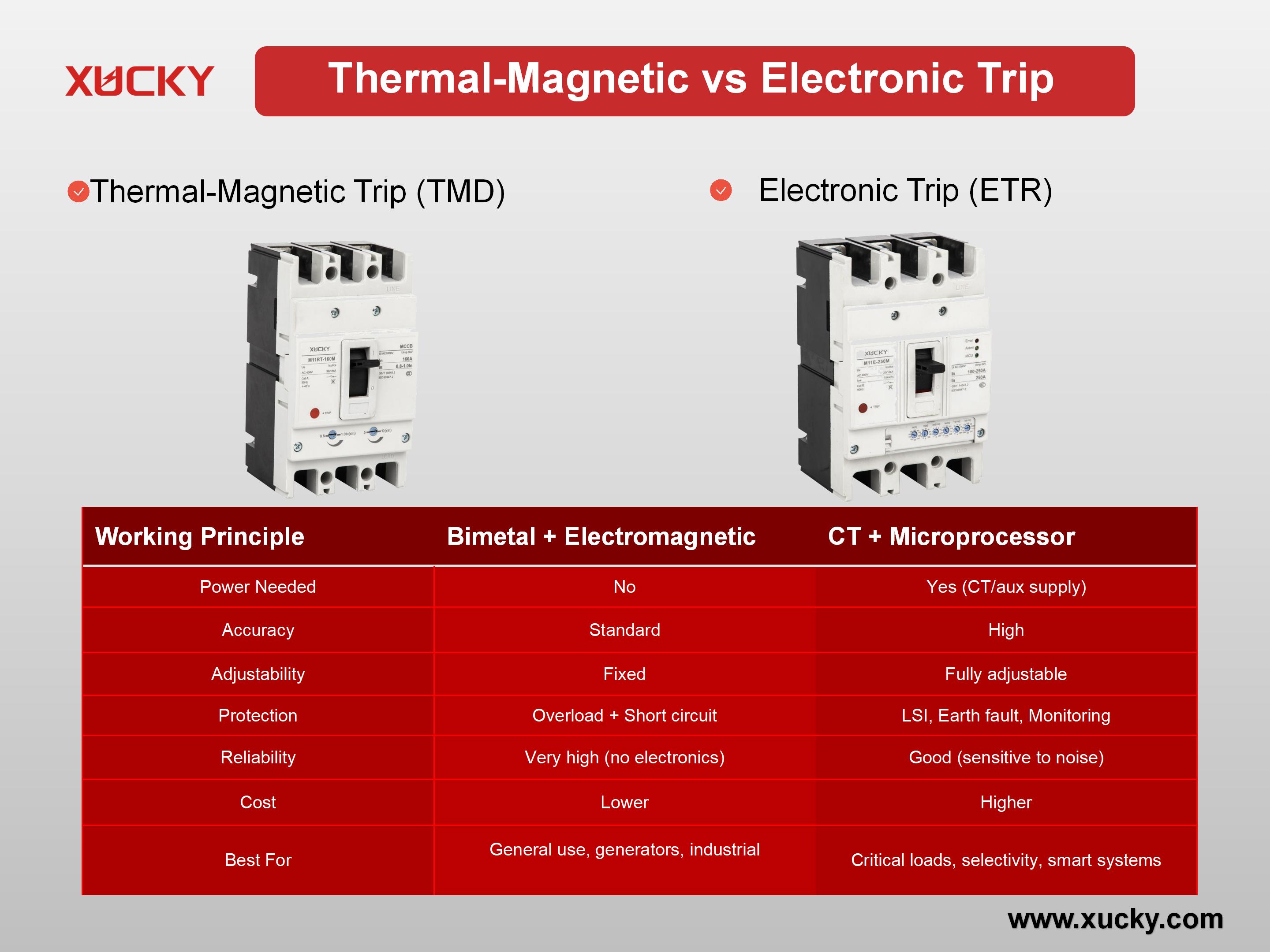
Construction: Often features interchangeable trip units (thermal-magnetic or electronic) that can be adjusted for current and time delay.
Size: Larger frame sizes, usually mounted on a base or in switchgear.
MCCBs offer adjustable protection settings, making them ideal for feeder circuits where coordination with downstream devices is critical. Electronic trip units can provide advanced functions like ground fault protection, zone selective interlocking, and communication capabilities.
| Feature | MCB | MCCB |
| Rated Current Range | Up to 125A | 10A to 2500A+ |
| Breaking Capacity | ≤ 25kA (typical) | Up to 200kA |
| Trip Unit | Fixed (thermal-magnetic) | Fixed or interchangeable (thermal-magnetic or electronic) |
| Adjustability | None | Yes (current, time delay) |
| Application | Final branch circuits, lighting, sockets | Feeders, main panels, heavy equipment |
| Mounting | DIN rail | Fixed or plug-in base |
| Typical Pole Count | 1P, 2P, 3P, 4P | 3P, 4P (also 2P for smaller frames) |
| Certification | IEC 60898-1, IEC 60947-2 | IEC 60947-2 |
The decision between MCB and MCCB depends on three main factors: current demand, fault level, and need for adjustability.
When to Choose MCB
Residential and Small Commercial Buildings: Lighting circuits, socket outlets, small appliances. Currents rarely exceed 63A and fault levels are low.
Sub-distribution Boards: Protecting final circuits downstream of an MCCB or main switch.
DIN Rail Panels: Where space is tight and modularity is required.
Cost-Sensitive Projects: MCBs are significantly cheaper than MCCBs.
When to Choose MCCB
Industrial Plants: Motors, pumps, compressors, welding machines—equipment with high inrush currents and higher fault capacity.
Main Switchboards: As the main incoming protective device for a building or a large panel.
Feeder Circuits: Distributing power to subpanels where coordination and selectivity are essential.
High Fault Current Locations: Near transformers or generators where short-circuit currents exceed 10kA.
Adjustability Needs: When you need to fine-trip protection settings to match variable loads or to achieve selective coordination.
A. Breaking Capacity (Icu / Icn)
Always ensure the breaker's breaking capacity exceeds the prospective short-circuit current at the point of installation. For example, if a panel has a fault level of 25kA, a standard MCB rated at 10kA would fail catastrophically. In such cases, either use an MCCB or a current-limiting MCB with higher rating.
B. Selectivity (Discrimination)
When breakers are connected in series (e.g., MCCB feeding MCBs), you must ensure that a fault downstream trips only the nearest breaker. MCCBs with adjustable time delays allow you to achieve this "selectivity" easily, whereas MCBs are instantaneous and may not coordinate with upstream devices without careful selection.
C. Temperature Derating
Both MCBs and MCCBs are affected by ambient temperature. Their thermal elements are calibrated at 30°C or 40°C. If installed in a hot environment, they may trip earlier than expected—or require derating. Consult manufacturer data (like XUCKY's technical datasheets) for correction factors.D. Type of LoadHighly inductive loads (motors, transformers) may require Type C or D MCBs to avoid nuisance tripping during startup. MCCBs with electronic trip units can be programmed for motor protection with specific time-current curves.
MCB is a low-cost, disposable component. If it fails, you replace it. It is not designed for repair.
MCCB is a significant investment. It often comes with replaceable parts (arc chutes, contacts, trip units) and can be maintained over decades. Electronic MCCBs add monitoring capabilities that reduce downtime and improve energy management.
For a small office, MCBs are perfect. For a factory with critical production lines, the extra cost of MCCBs is justified by their robustness and adjustability.
| If your circuit... | Choose |
| Is a lighting or socket outlet in a house | MCB |
| Has current < 63A and fault level < 6kA | MCB |
| Is a feeder to a subpanel in a commercial building | MCCB (or high-current MCB if <125A) |
| Powers a large motor (30kW+) | MCCB |
| Needs adjustable protection settings | MCCB |
| Is the main incoming supply for a factory | MCCB |
| Requires communication with a BMS | MCCB with electronic trip unit |
At XUCKY, we manufacture both MCBs and MCCBs to the highest international standards (IEC 60898-1, IEC 60947-2). Our range includes:
XUCKY MCB Series: 1P to 4P, 6A-63A, B/C/D curves, 6kA/10kA breaking capacity—ideal for residential and commercial final circuits.
XUCKY MCCB Series: 16A to 1600A, thermal-magnetic and electronic trip units, up to 100kA breaking capacity—engineered for industrial and main distribution applications.
We help you select the right breaker for your specific application, ensuring safety, reliability, and cost-effectiveness. Contact us for technical support or a quote.