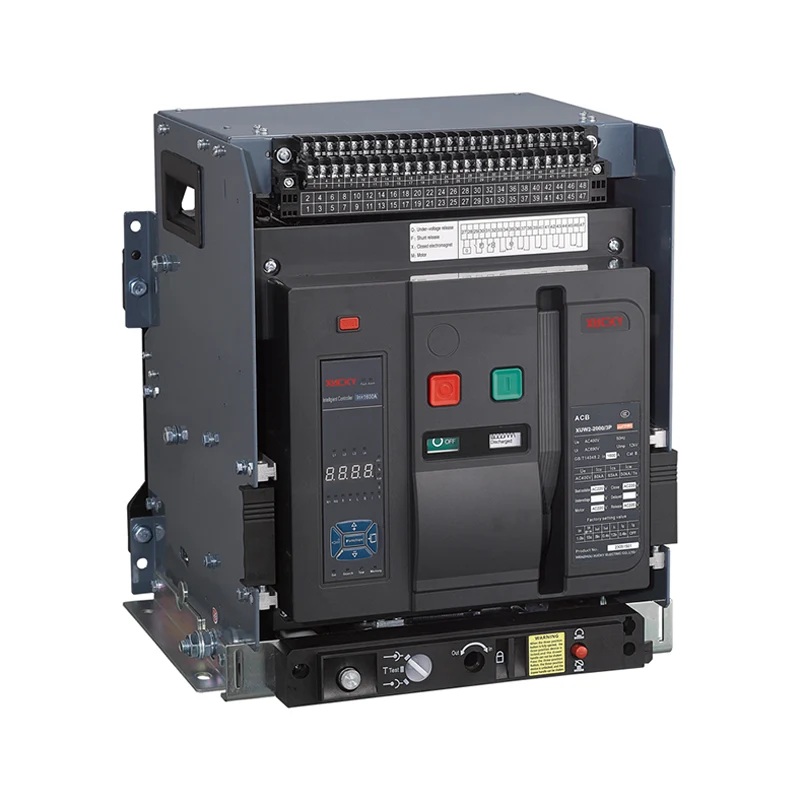
XUCKY Electric XUW1 Air Circuit Breaker is increasingly referenced in modern power safety planning where electrical fire prevention has become a critical concern in dense industrial and commercial environments. In facilities such as manufacturing floors, distribution centers, and high-rise buildings, electrical faults can escalate quickly, making fast isolation and system stability essential for reducing risk and downtime.
Rather than focusing only on equipment structure, it is more meaningful to understand how protection systems behave when real electrical anomalies occur. The Air Circuit Breaker is designed around this operational reality, combining fault detection logic, fast interruption capability, and layered protection settings that respond differently depending on the type and severity of the electrical disturbance.
Electrical fires rarely start from a single dramatic failure. They usually develop from gradual stress in circuits or unnoticed abnormalities that accumulate over time.
In most medium and large-scale power distribution systems, the following conditions are the most frequent contributors:
- Overload caused by excessive simultaneous equipment usage
- Short circuit due to insulation breakdown or wiring failure
- Grounding faults creating unintended current paths
- Undervoltage conditions affecting control stability
- Loose connections generating localized heat
Each of these conditions can produce heat buildup, and when protection response is delayed, the risk of insulation ignition increases significantly.
In this context, fast and selective disconnection becomes a key requirement rather than an optional function.
The XUW1 Air Circuit Breaker is structured around a multi-layer detection and interruption system. Instead of reacting in a single fixed way, it adjusts protection behavior based on current type, magnitude, and duration.
The protection system generally includes:
- Long-delay protection for sustained overloads
- Short-delay protection for intermediate faults
- Instantaneous response for severe short circuits
- Ground fault detection for leakage-related risks
These stages work together to ensure that minor fluctuations do not cause unnecessary shutdowns, while serious faults are isolated immediately.
Modern distribution networks often require communication between devices. The breaker supports adjustable settings and monitoring functions that allow operators to define protection thresholds based on load characteristics. This adaptability helps maintain continuity in critical environments such as hospitals, data centers, and production lines.
At this stage, the role of Air Circuit Breaker becomes more evident, especially in systems where selective coordination between multiple breakers is required to isolate only the affected section.
To understand how protection translates into real-world safety, it is useful to break down the response behavior into practical outcomes.
| Electrical Fault Type | Detection Method | Breaker Response | Safety Outcome |
| Overload | Current exceeds rated threshold over time | Long-delay trip | Prevents overheating of cables |
| Short Circuit | Sudden high current spike | Instant trip | Stops arc and fire ignition risk |
| Ground Fault | Leakage current detection | Controlled disconnection | Reduces shock and fire hazard |
| Undervoltage | Voltage drop monitoring | Triggered release | Protects equipment stability |
This layered response structure ensures that different fault types are handled with appropriate timing rather than a one-size-fits-all shutdown.
In modern infrastructure, electrical distribution is not limited to a single room or system. Instead, it spans multiple floors, integrated automation systems, and continuously operating equipment.
In tall buildings, power is distributed vertically through risers. A fault in one section can potentially affect multiple floors if not isolated quickly. A device like the Air Circuit Breaker helps localize faults, reducing the risk of widespread outage or cascading failures.
In production environments, sudden shutdowns can be as disruptive as electrical faults themselves. Therefore, protection systems are expected to be both fast and selective. This balance is essential to maintain operational continuity while still prioritizing safety.
The ability to fine-tune protection curves allows engineers to match breaker behavior with real load profiles rather than relying on fixed assumptions.
Electrical protection equipment must operate consistently under both normal and extreme conditions. For this reason, design validation typically follows internationally recognized standards such as IEC 60947-2 and GB 14048.2.
The testing process generally includes:
- Thermal endurance testing under sustained load
- Short-circuit interruption performance verification
- Mechanical durability cycling tests
- Environmental adaptation checks under temperature and humidity variation
- Insulation and dielectric strength assessment
These tests ensure that performance remains stable even when environmental conditions change, such as high humidity or elevated altitude installations.
The XUW1 Air Circuit Breaker is designed with these requirements in mind, particularly for distribution networks operating up to 660V–690V systems with high current ranges.
Electrical systems are not installed in controlled laboratory conditions. They must operate in environments that vary widely in temperature, dust exposure, and humidity levels.
Typical operational parameters include:
- Ambient temperature range from -5°C to +40°C
- Altitude up to 2000 meters
- Relative humidity up to 90% under non-condensing conditions
- Protection level suited for industrial environments
- Installation flexibility in fixed or drawer-type configurations
These parameters ensure that protection behavior remains consistent regardless of location differences, whether in urban infrastructure or remote industrial zones.
In addition, communication-ready interfaces allow integration into automated monitoring systems, supporting centralized control strategies for modern electrical grids.
To better understand practical behavior, consider a simplified scenario in a distribution cabinet:
- A motor load gradually increases beyond rated current
- The breaker detects sustained overload condition
- Long-delay protection begins timing cycle
- If load persists, controlled trip is executed
- Nearby circuits remain unaffected due to selective coordination
In another scenario involving a short circuit:
- Sudden current surge is detected
- Instantaneous protection triggers within milliseconds
- Arc formation is interrupted before sustained heat develops
- Power is isolated to the affected branch only
These response patterns demonstrate how layered protection logic reduces the likelihood of electrical fire escalation.
As electrical infrastructure becomes more automated, protection devices are no longer standalone components. They now interact with monitoring systems, remote control platforms, and predictive maintenance tools.
The Air Circuit Breaker supports this transition by offering communication capability and configurable protection parameters. This allows system designers to align electrical protection behavior with real-time operational data rather than static design assumptions.
Electrical fire prevention in complex power networks depends heavily on how quickly and accurately faults are identified and isolated. Through layered protection logic, adaptable configuration, and standardized testing compliance, the XUW1 Air Circuit Breaker plays a structured role in maintaining distribution safety across demanding environments. Within the broader engineering approach of XUCKY Electric, it represents a practical response to modern electrical risk conditions in both industrial and high-rise applications.